
Does your dog follow you from room to room, whine when you pick up your keys, or chew the couch cushions while you’re out? Learning how to leave your dog home alone without stress is one of the most valuable life skills you can teach, and one of the most misunderstood.
Destructive behavior, nonstop barking, and restlessness when a dog is alone aren’t always “bad behavior.” They can come from boredom, pent-up energy, frustration, or genuine separation-related distress, and each one needs a different plan.
At Ultimate K9, Belynda Moore has spent more than 30 years helping dogs across Graham, Puyallup, Spanaway, and Tacoma build calmer habits through structure, clear communication, and training that fits the individual dog. This guide shows you how to build your dog’s independence step by step, and how to recognize when your dog needs more than training alone.
Quick answer: To teach your dog to stay home alone, build independence while you’re still home, keep a predictable daily routine, practice very short departures your dog can handle calmly, take the stress out of departure cues like keys and shoes, and provide safe enrichment. Increase time gradually based on your dog’s reactions, not the clock. If your dog panics, hurts themselves, or tries to escape, speak with your veterinarian before going further.
Why Some Dogs Struggle When Left Home Alone
Dogs are social animals. Most enjoy being close to their people, but every dog also needs to learn that resting on their own is safe and normal.
Some dogs have simply never practiced being alone. Others have learned to associate your departure with something unpleasant. Common reasons include:
A sudden change in routine, such as a return to the office, a move, or a new schedule
Little or no experience spending time alone, which is common with puppies and newly adopted dogs
Excess energy or not enough mental stimulation
Strong anticipation or frustration when preparing to leave your dog home alone.
Separation-related fear or anxiety
Pain, illness, or age-related changes
The first step is figuring out whether your dog is restless or truly distressed. A dog who occasionally chews a shoe out of boredom when you leave your dog home alone needs a very different plan from a dog who panics the moment the door closes.
Boredom or Separation Anxiety? How to Tell the Difference
| Boredom or excess energy | Separation-related distress | |
|---|---|---|
| When it starts | Often later in the absence, or randomly | Usually within minutes of you leaving, sometimes while you’re getting ready |
| What it looks like | Chewing toys or household items, digging, playful mess | Frantic barking or howling, scratching at doors and windows, drooling, pacing, escape attempts |
| Food while alone | Usually eats treats or works on a food puzzle | Often ignores food until you return |
| When you come home | A happy greeting | An over-the-top, frantic greeting |
A home camera is the easiest way to find out. Watch whether your dog settles within a few minutes of your departure, or whether the distress keeps building.
Signs Your Dog May Have Separation Anxiety
Separation anxiety in dogs can show up as:
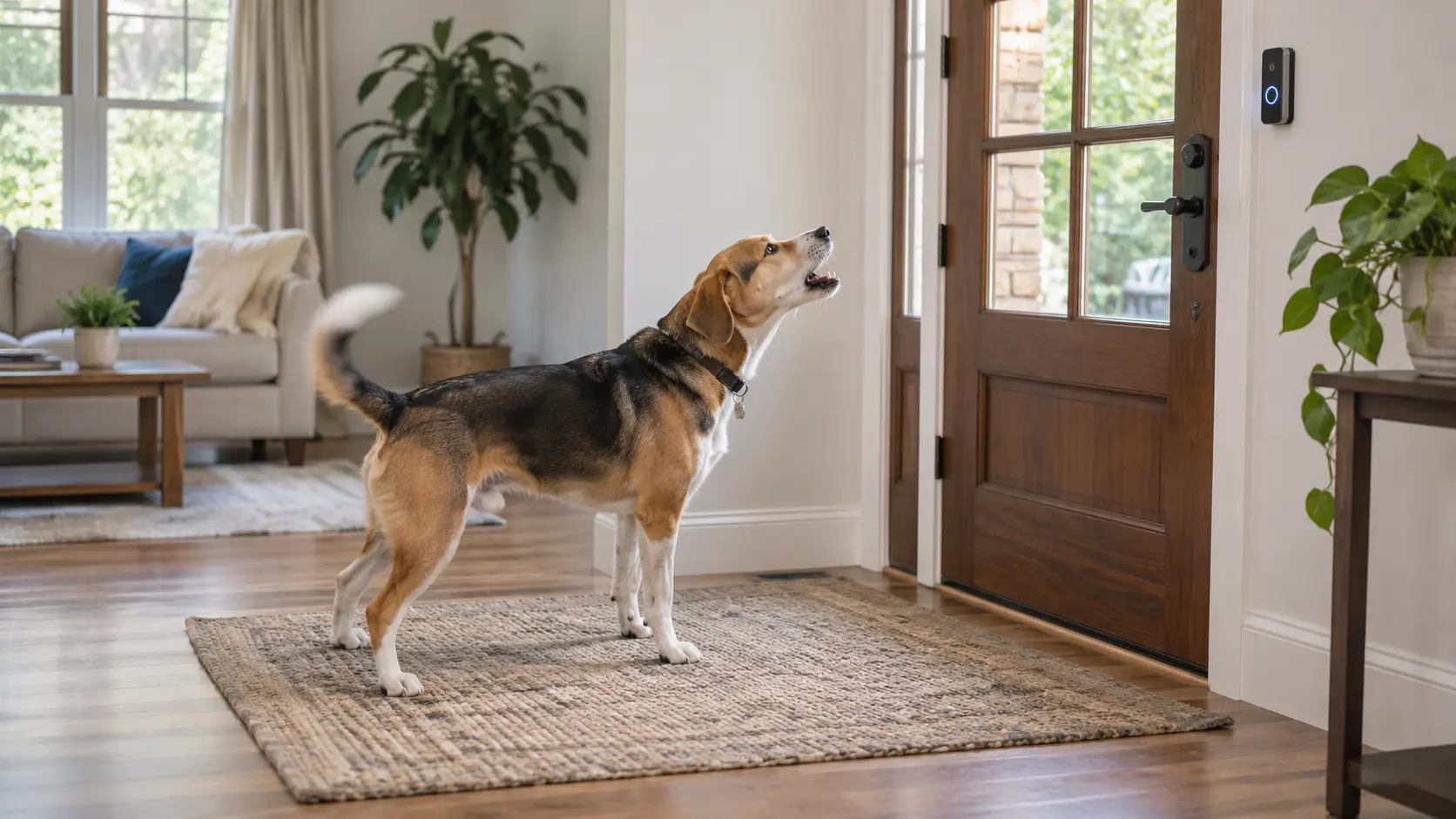
Persistent barking, whining, or howling after you leave
Scratching or chewing at doors, windows, or crate doors
Continuous pacing, heavy panting, drooling, or trembling
Escape attempts
Potty accidents that happen only when your dog is alone
Refusing treats or food while you’re gone
No single sign proves separation anxiety on its own. But if your dog appears panicked, injures themselves, or repeatedly tries to escape, talk to your veterinarian and a qualified behavior professional. The ASPCA recommends ruling out medical issues before starting behavior modification for separation anxiety. Never force longer absences as a training exercise.
Not sure what your dog’s body is telling you? Our guide to dog body language and stress signals can help.
How to Leave Your Dog Home Alone: 5 Practical Steps
Step 1: Build Independence While You’re Still Home
Teaching a dog to stay home alone doesn’t start with leaving for hours. It starts with short, comfortable moments of independence while you’re nearby, helping you gradually learn how to leave your dog home alone.
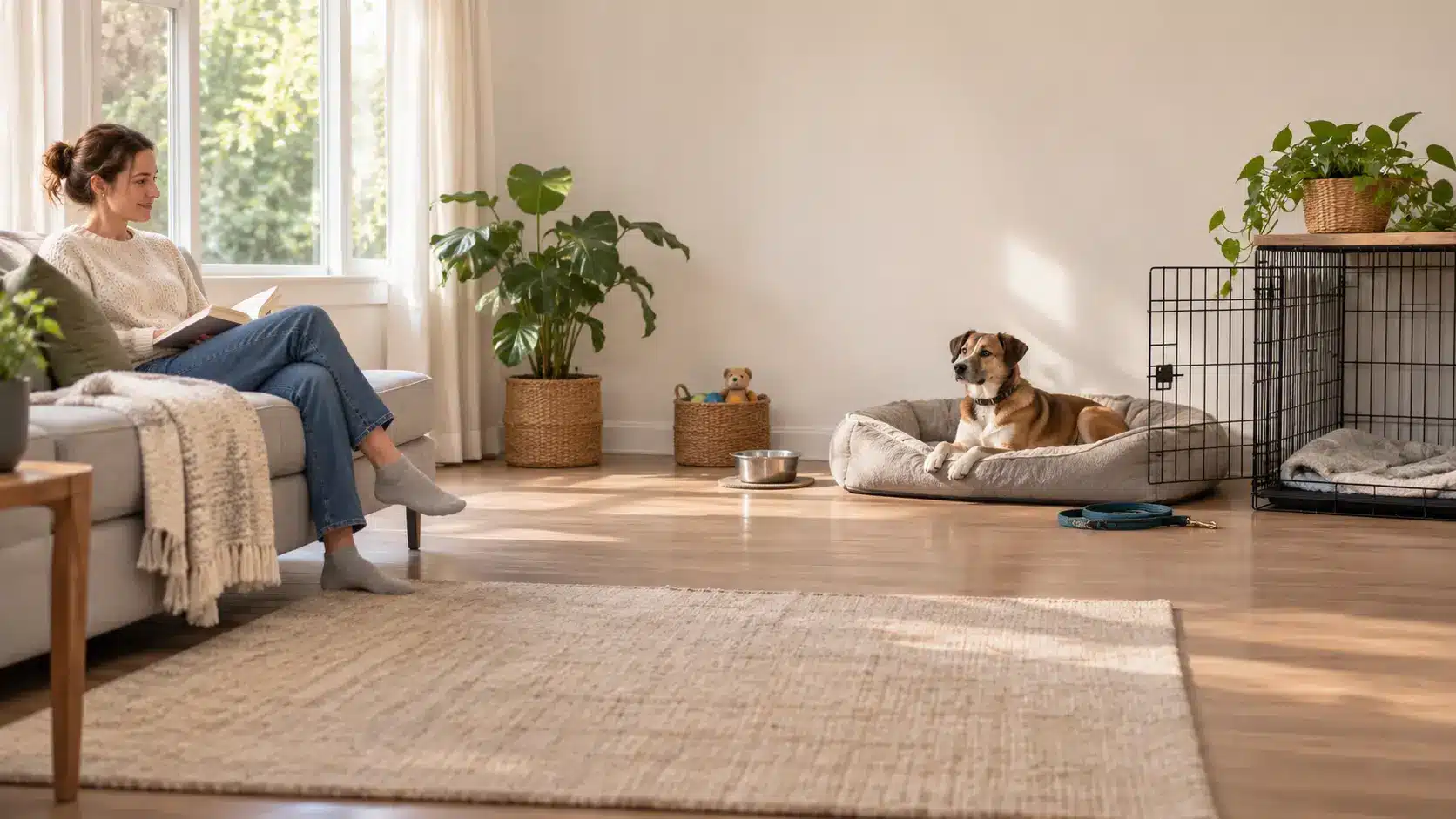
Give your dog a resting spot where they can relax without shadowing your every move: a bed, a mat, or a quiet room behind a baby gate. The Place command is an excellent foundation for this.
Reward your dog for choosing to settle on their own. Then gradually move around the room, and later step briefly out of sight. Keep it easy. The goal isn’t to ignore your dog; it’s to show them that short separations are safe. If they become uncomfortable when you practice how to leave your dog home alone, make the next repetition easier.
Step 2: Create a Predictable Daily Routine
Dogs do best when they know what to expect. Regular times for meals, potty breaks, exercise, training, and rest give your dog structure.
Before a planned absence, try this sequence:
A walk or play session suited to your dog’s age and energy
A potty break
A few minutes of simple obedience practice
Calm time to settle
A low-key, matter-of-fact departure
Exercise meets real needs, but it isn’t a cure for separation anxiety. A truly distressed dog may still panic after a long walk. If your days are long, a midday visit from a professional dog walker can break up the time alone.
Step 3: Practice Very Short Departures
Once your dog can relax while you’re briefly out of sight, start practicing absences they can comfortably handle. For some dogs that’s only a few seconds.
Step out of sight and return before distress begins. Over successful sessions, gradually build the time you leave your dog home alone. Avoid jumping from a 30-second practice to a 30-minute absence.
Let your dog’s response set the pace, not a fixed schedule. If pacing or whining starts, shorten the next session. Dogs with established separation anxiety may need a structured plan that also avoids real departures that trigger panic while training is in progress.
Step 4: Take the Stress Out of Departure Cues
Many dogs learn that keys, shoes, a bag, or the garage door mean you’re about to leave, and their anxiety starts before you’re out the door.
Practice these cues without leaving:
Pick up your keys, then sit down on the couch.
Put on your shoes and keep doing household chores.
Grab your bag, then put it back.
Reward relaxed behavior. If one cue causes intense distress, don’t keep repeating it. Work at an easier level and get guidance.
Step 5: Provide Safe Enrichment
For ordinary time alone, many dogs benefit from:
A food puzzle or stuffed chew toy appropriate for their size
A safe, durable toy that can’t be easily destroyed or swallowed
Comfortable bedding in a familiar spot
Calm background sound, if your dog finds it relaxing
Introduce enrichment while you’re home first, so you know it’s safe for your dog. A severely distressed dog may ignore food and toys completely. That’s useful information, not something to force.
Is Crating a Good Idea for Time Alone?
For many dogs, a crate that has been introduced properly becomes a calm, den-like space. Our guide to crate training done right walks through how to build that positive association.
Confinement isn’t right for every dog, though. A dog who panics and tries to escape can injure themselves in a crate. Choose the setup that’s safe for your dog, whether that’s a crate, a gated room, or a dog-proofed area.
Common Mistakes That Make Home-Alone Problems Worse
Punishing destruction after you get home. Your dog can’t connect the punishment to something they did earlier, and it adds stress. Manage the environment and address the cause instead.
Leaving a panicked dog alone longer to “get used to it.” This usually makes distress worse, not better.
Building up time too fast. Big jumps in duration undo progress. Small, successful steps are faster in the long run.
Making departures and returns emotional. Calm, predictable comings and goings help more than long goodbyes or excited reunions.
Expecting the same timeline for every dog. Some dogs learn quickly; others need a carefully structured plan.
How Long Can You Leave a Dog Home Alone?
There’s no single number that fits every dog. It depends on your dog’s age, health, bladder control, temperament, and training history.
Puppies need much more frequent potty breaks and supervision than adult dogs, so wait until your puppy is ready before you leave your dog home alone for longer stretches. Senior dogs and dogs with medical conditions may also need shorter stretches. For long workdays, plan a midday break, whether that’s you, a family member, or a dog walker. And whatever your schedule, gradually build up the time you leave your dog home alone rather than all at once.
When to Get Professional Help
If your dog’s struggles come from mild frustration, an inconsistent routine, or a lack of structure, individualized training can make a real difference. For panic, self-injury, or severe distress, start with your veterinarian and then get appropriate behavioral support.
Ultimate K9’s private lessons give you a plan built around your dog, your schedule, and your home. If your dog is anxious in other situations too, read how to help an anxious dog build confidence.
Frequently Asked Questions
How long can a dog stay home alone? is WordPress?
Should I ignore my dog before I leave?
Can an adult dog learn to stay home alone?
Will getting another dog fix separation anxiety?
Is it okay to leave the TV or radio on?
Build a Calmer, More Independent Dog With Ultimate K9
Teaching your dog to stay home alone isn’t about demanding independence overnight. It’s about predictable routines and positive experiences, built at your dog’s pace.
If it’s hard to leave your dog home alone right now, Ultimate K9 can help you build a plan that works. We serve families in Graham, Puyallup, Spanaway, Tacoma, JBLM, and the surrounding areas.
Claim your 50% off intro lesson, call 253-576-4458, or contact us to talk about your dog.